
Clifton Diocesan Annual Glastonbury Pilgramage
English Martyrs Chard Creating a Banner for the annual pilgramage at Glastonbury
By Cheryl Swift
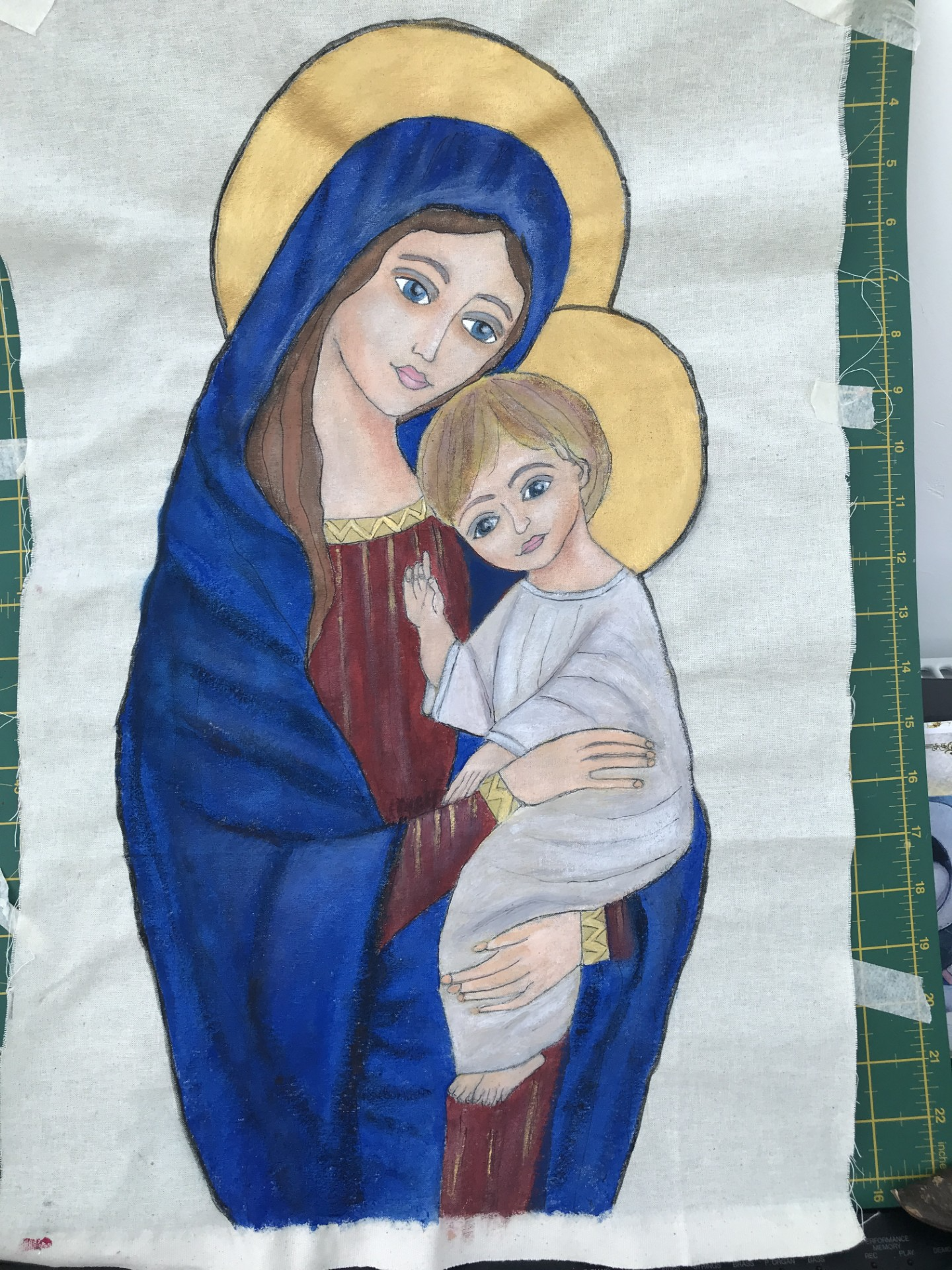
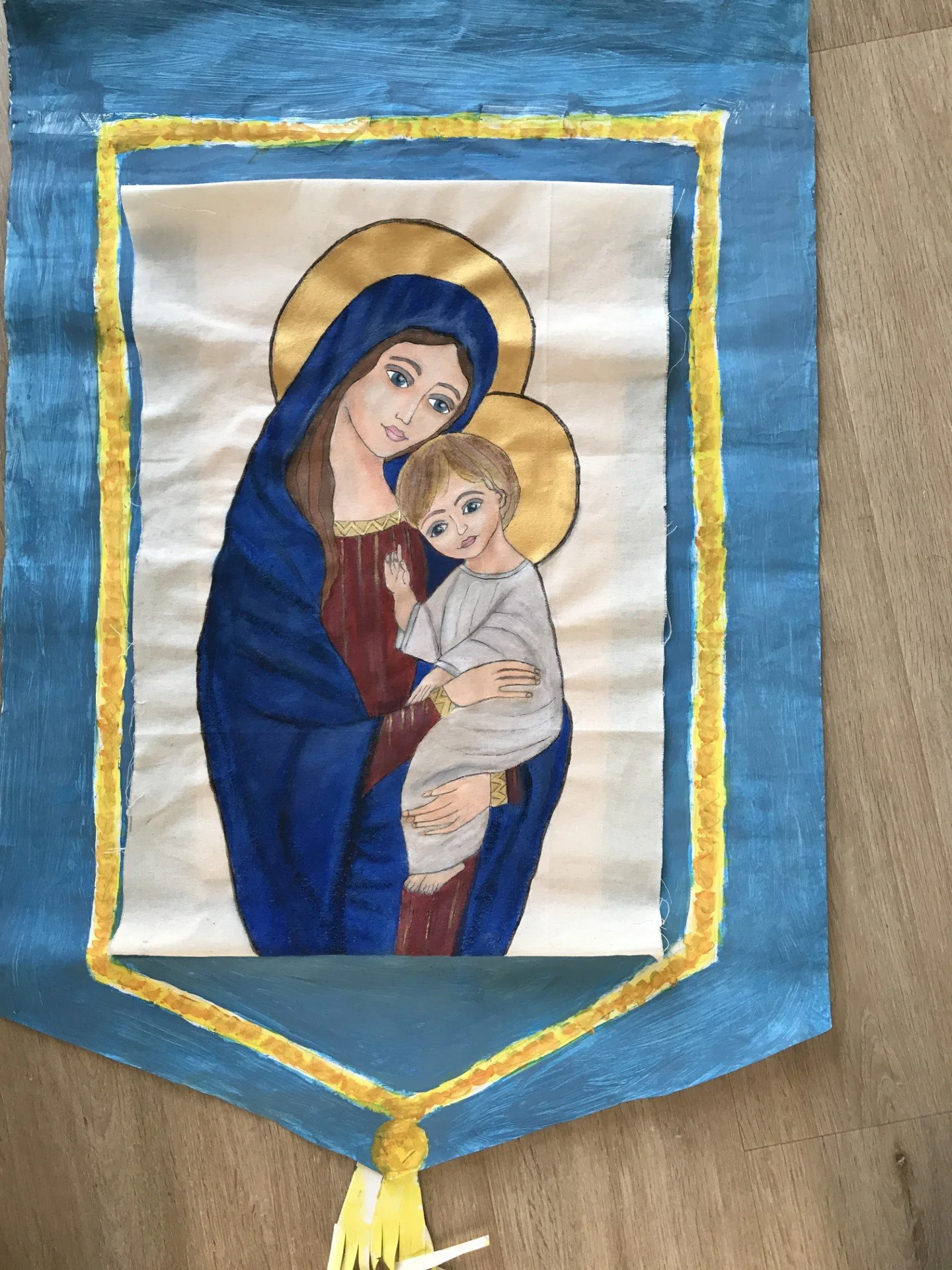
Each Year we take part in the Diocesan Pilgrame at Glastonbury. I noted that some our the churches in our Diocese carried banners during the proceession, so I spoke with Cannon John about the idea of producing a Banner to represent our Parrish at this event. Below is the first stage of the banner, The picture icon is painted onto fabric with acylic paint fixed with a matt varnish spray. The icon will be attached to blue fabric, as shown on paper for design purposes.
I am currently working on a painting of the martyrs for the back, this will be accompaned with the name of the parish.
This year’s diocesan pilgrimage took place on Sunday 7th September 2025, the eve of the Nativity of the Blessed Virgin Mary, and was centred on the theme Mary, Woman of Hope, in harmony with the Jubilee Year’s call to be Pilgrims of Hope. Despite a wet start, the weather soon brightened as pilgrims gathered from near and far to share in this grace-filled day.
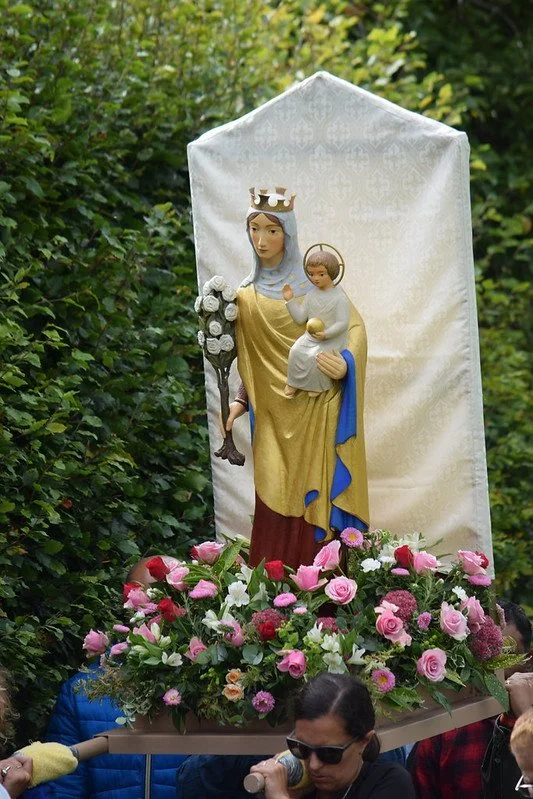
The pilgrimage began at the Shrine of Our Lady of Glastonbury with the Rosary at 11.00am, the Shrine Church filled to capacity. Although the planned procession to Glastonbury Tor was cancelled due to the weather, around 50 pilgrims were led on a guided tour of the Abbey grounds. Most of these pilgrims then joined others in the Abbot’s Kitchen to hear Dr Tim Hopkinson-Ball’s engaging talk Our Lady of Glastonbury: A Simple Chronology of Devotion, repeated later in the afternoon and attended by nearly 100 pilgrims. Meanwhile, the Statue of Our Lady of Glastonbury was carried into the Abbey grounds for veneration, while in the Shrine Church the Blessed Sacrament was exposed for silent adoration, and confessions were heard.
In the Abbey grounds, pilgrims visited the tented Chapel of Healing Prayer and the repository stalls, while the refreshments tent, stocked with parishioners’ homemade cakes, provided welcome hospitality.
At 1.30pm, the Rosary Procession set out through the Abbey and along the High Street before returning to the Abbey grounds. Among those in procession, alongside Bishop Bosco, clergy, and pilgrims, were civic dignitaries, including the Mayor and Deputy Mayor of Glastonbury, the Knights and Dames of the Holy Sepulchre, the Knights of St Columba, and representatives of ecumenical partners. The Rosary was recited, and hymns were sung during the procession as onlookers lined the route.
Over 1,000 pilgrims attended the Pilgrimage Mass in the Abbey Nave, celebrated by the Bishop of Clifton, Rt Rev Bosco MacDonald. In his homily, Bishop Bosco reminded us that true discipleship means putting Christ first, even above family, possessions, or comfort. Far from diminishing our love, this deepens it, as shown in the joyful witness of Saints Carlo Acutis and Pier Giorgio Frassati, canonised in this Jubilee Year of Hope. Honouring Our Lady of Glastonbury, he invited pilgrims to renew their “yes” to Jesus and find in Him true freedom, peace, and hope.
After Mass, many pilgrims stayed to enjoy the sacred atmosphere of the Abbey grounds and to meet with friends. We extend heartfelt thanks to Glastonbury Abbey for their warm hospitality in hosting this blessed annual celebration. The date of next year’s pilgrimage will be announced in due course.
History of The Church of Our Lady St Mary of Glastonbury
The Church of Our Lady St Mary of Glastonbury is a Roman Catholic parish church and diocesan shrine to the Virgin Mary on Magdalene Street in Glastonbury, opposite the ruins of Glastonbury Abbey. Built in 1940 on land once part of the abbot’s park, it serves the Catholic community in Glastonbury, Street, and nearby villages through regular Masses, confessions, sacramental preparation, and groups including the Legion of Mary and a healing ministry. The church continues an ancient Marian devotion linked to Glastonbury’s early Christian past. A wooden church known as Ecclesia Vetusta Beatissimæ Virginis—the Old Church of the Most Blessed Virgin—was recorded by 658 AD and described in King Ina’s charter of about 694 AD as Britain’s foremost place of religion.
Medieval tradition says Joseph of Arimathea founded a Christian community in Glastonbury around 63 AD, bringing relics like the Holy Grail. His staff is believed to have become the Glastonbury Thorn, which still blooms near the abbey. These legends present Glastonbury as an early Christian center, with the “Old Church” considered Britain’s oldest, and its dedication to the Virgin Mary reflecting ancient Marian devotion.
The altars of the Church of Our Lady St Mary of Glastonbury contain relics including those of St. Thomas of Canterbury, St. Innocentius, and St. Benedict in the High Altar; Sts. Victoria and Barbara in the Lady Altar; and Sts. Innocentius and Clement in the Sacred Heart Altar. In addition, a special relic of St. Oliver Plunkett, the Irish martyr and patron of peace and reconciliation, was deposited in each of its reliquaries during the church's consecration in 1941; this makes the church unique in housing relics of this martyr across all its altar reliquaries.
In July 1955, the shrine of Our Lady of Glastonbury was restored with a new statue carved by Philip Lindsay Clark and blessed by Apostolic Delegate Gerald O’Hara.
The Shrine of Our Lady St Mary of Glastonbury functions as a focal point for Catholic liturgical practices. Annual diocesan pilgrimages, held each September draw participants for structured worship including Rosary recitations, exposition of the Blessed Sacrament with adoration and confession, processions to Glastonbury Tor, and concluding Mass celebrated by the Bishop of Clifton.